My research considers how individuals and societies as well as markets and industries adjusted to constantly, and often cataclysmically, changing economic and social circumstances in the Middle Ages.

Dr. Jordan Claridge
Medieval Economic Historian

My research considers how individuals and societies as well as markets and industries adjusted to constantly, and often cataclysmically, changing economic and social circumstances in the Middle Ages.
Books
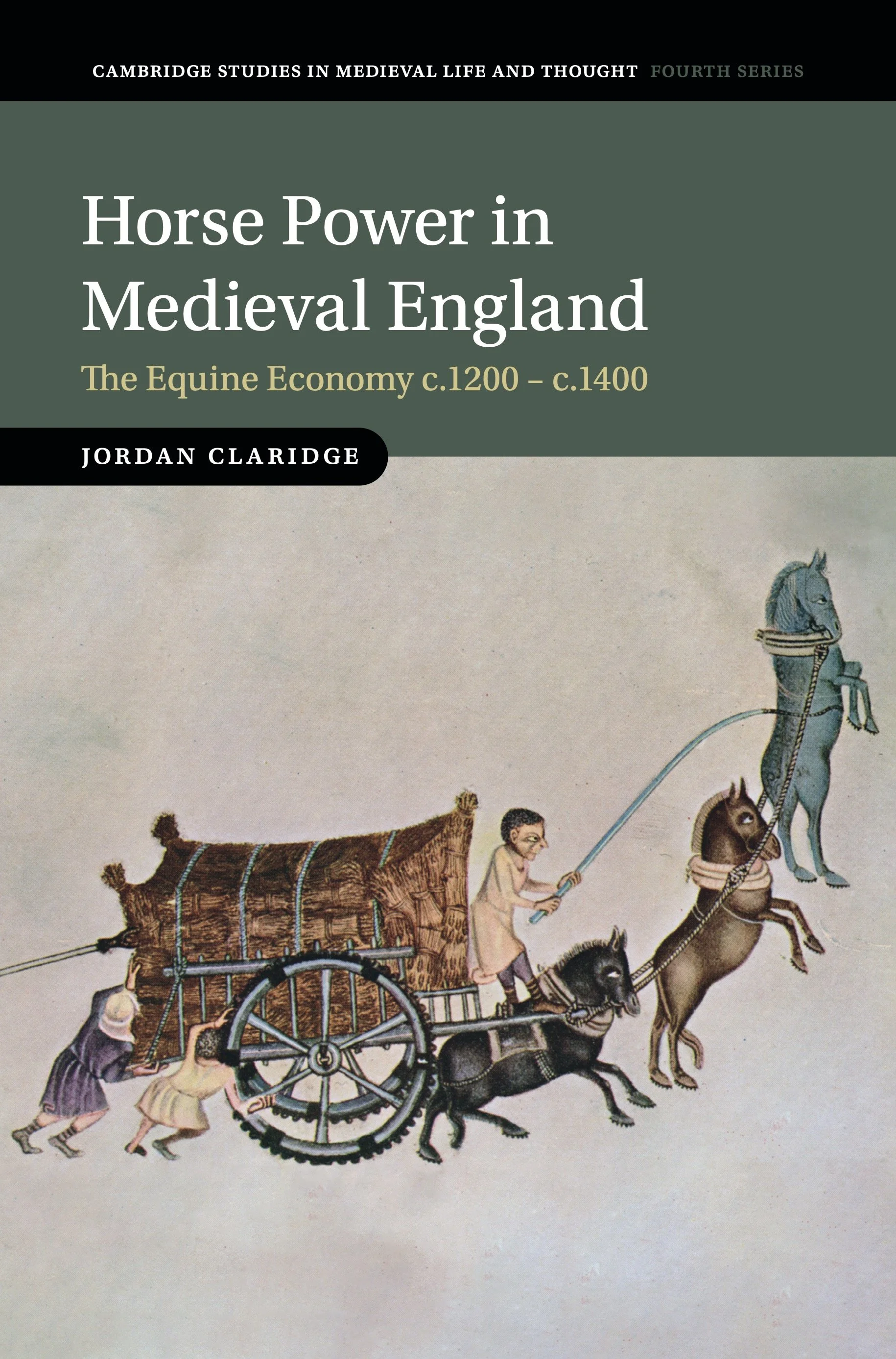
Horse Power in Medieval England offers the first systematic reconstruction of the medieval horse trade to answer how medieval England was supplied with working horses, the most critical source of energy during a particularly important period of England’s (and indeed Europe’s) economic development from the thirteenth to fifteenth centuries. Drawing on an extensive body of manorial accounts, court rolls and tax records, the book shows that lords’ demesnes were significant consumers of working horses but rarely produced enough horses to meet their own demand. This gap was filled by an extensive, decentralized network of small-scale peasant breeders who produced horses as an adjunct to mixed-farming pursuits where local conditions were suitable. This adds nuance to our understanding of the process of commercialization by demonstrating that it was catalysed by peasant producers whose participation in markets was both necessary and extensive. Peasant participation in the horse trade diversified household incomes and expanded engagement with markets, illustrating how commercial growth could emerge without large-scale investment and that peasants played a vital role in England’s medieval economic development; they were integral to supplying the very power that enabled markets to thicken, goods to circulate and towns and cities to grow.
This paper attempts to move beyond the focus on ‘average’ wage trends in pre-industrial economies by examining the broad diversity of pay rates and forms of remuneration of agricultural labourers in medieval England. It argues that wage inequality in post-Black Death England reflects the uneven penetration of market forces across occupations and regions, with deep-rooted customary structures continuing to shape remuneration, particularly through in-kind payments. This paper explores the dynamics of wage inequality in medieval England, demonstrating that the Black Death brought wage gains for some, but did not benefit all labourers equally. Whilst there was commercialization in labour markets, custom and uneven market forces remained significant for wage inequality in medieval England.
With Vincent Delabastita and Spike Gibbs
This paper explores the prevalence of in-kind wages in medieval labour markets and the underlying reasons for their use. Using a new dataset of agricultural labourers in medieval England, we demonstrate that, until the late fourteenth century, wages were recorded anonymously and most remuneration was done through in-kind payment. From the 1370s, however, labour remuneration shifted increasingly to cash and workers began to be named individually in the accounts which recorded their wages. We argue that these changes reveal a fundamental shift in labour relations in late medieval England, providing new empirical insights into the ‘golden age of labour’ that followed the Black Death.
This aim of this paper is to examine how a single English demesne (the personal farm of a seigniorial lord, as opposed to the land of their peasant tenants) managed its stock of working horses over a period of almost 170 years. It leverages the exceptionally rich body of surviving manorial accounts from the Battle Abbey manor of Barnhorn to look very closely, not only at how the demesne managed its horses, but how it operated within the context of the larger Battle Abbey estate.
With Spike Gibbs
This article seeks to provide new insights into long-standing debates on lord-tenant relations and how they were negotiated through the manorial court in medieval England. This is accomplished through a study of the ‘stray system’: an institution within which lords and tenants cooperated to manage stray livestock. Specifically, the article argues that the stray system is a clear example of a ‘public good’. In this context, it was a social benefit provided by lords to their tenants as a collective. In a world where most of the population was reliant on an unproductive agriculture, subject to the vagaries of the environment, to provide a basic livelihood, any potential damage to a crop would have been a very real concern. However, in managing the threat of wandering livestock, the property rights of owners had to be clearly protected to avoid violent disputes stemming from accusations of theft and conflict over ownership. The manorial court’s management of strays provided an institution to resolve these countervailing pressures. Ultimately, it protected a community’s arable land – the most vital source of income for lords and tenants alike – whilst simultaneously assuring the property rights of those who had lost important capital assets in the form of livestock.
This paper explores the question of how medieval England was supplied with working horses. It uses a national sample of over 300 manorial accounts from c .1300 to assess the role of demesnes in the production and distribution of these animals. It finds that demesnes were significant net consumers of horses, relying primarily upon the market for their supply. This illustrates that there was a well-established market for these animals by c .1300, but also that these large institutional farms did not breed enough horses to sustain their own demand, let alone a surplus that could have supplied the market. Demesne managers did, however, fill an important distributive role in the trade of agricultural horses by acting as ‘middle men’ in marshalling the various channels of work horse acquisition and dispersion.
With John Langdon
This article explores the nature of agricultural labour in England c. 1300. Using a national sample of over 400 manorial accounts containing detailed data for over 4000 individuals, the piece looks closely at famuli labour, the nucleus of the workforce on seigneurial demesnes (the farms directly cultivated by manorial lords as opposed to the land of their tenants) at the beginning of the fourteenth century, a period considered to be the pinnacle of medieval population and intensive land exploitation. By examining the rates of remuneration as well as the availability of work for the range of famuli labourers, we argue that famuli labour was divided into a bipartite system of first- and second-tier workers where core, or first-tier (and mostly male), labourers such as ploughmen, carters, and shepherds were paid higher wages and presented with more opportunities to work as compared to a group of more subsidiary ‘second-tier’ labourers largely comprised of women, the young and the elderly.
With John Langdon
As a contribution to the long-running debate concerning the extent and motivation of medieval storage, this article uses purveyance accounts to examine such facilities in England prior to the Black Death. Three hundred and fifteen cases of predominantly urban storage were recorded for 97 communities for the products of agriculture purchased by the purveyors, mostly threshed grains. When these 315 cases were analysed using an Excel database, it was found that, in contrast to the often magnificent barns on monastic and other lordly estates, this storage was much smaller and informal, often indistinguishable, it seems, from the domestic storage for families themselves. As modest as it was, however, it likely played an important role in the increasing commercialization of medieval England, even perhaps to the extent of making society at the time more susceptible to subsistence crises.
With John Langdon
Medieval transport might strike the uninitiated as inherently primitive, but developments in the technology and infrastructure of getting goods and people around in the Middle Ages were constantly occurring. In the case of medieval England, they contributed critically to the commercialization in the country, particularly for the period from 1066 to around 1300. Nor was the story one of gradual and inexorable progress, but one of many twists and turns, as transport adjusted to major shifts in the social and economic environment, particularly when the Black Death struck in the middle of the 14th century. In broad terms, it appears that inland water transport developed quite significantly in the early medieval period (up to, say, 1300), but that land transport gradually improved to the extent that river navigation, while remaining important in certain parts of the country, especially the east, began an overall decline (although coastal shipping continued to be important). However, a particularly salient and as yet unexplained paradox was that, as commercial traffic increased, the legal and social framework for the upkeep of road and river transport networks seemingly relaxed, so that enforcement of the maintenance provisions of bridges and roads became more uncertain. Thus, over recent decades, medieval English transport has become situated more securely within larger social, economic and cultural visions of the period, as documentary, archaeological and iconographic studies with strong transport orientations have become more common and inventive.

The English Aversion to Eating Horseflesh, recently highlighted in a number of food scandals, dates back to the coming of Christianity.
Commissioned by History Today

